

Artificial intelligence is no longer an experimental technology. It now participates in approvals, recommendations, risk assessments, and customer interactions. So leadership faces a deeper question: “Can we justify, defend, and sustain it?”
By 2026, competitive advantage is no longer determined by model accuracy or processing speed alone. It is defined by institutional trust — the confidence customers, employees, regulators, and shareholders place in how AI systems are designed, governed, and held accountable in real-world decisions.
At Binalyto Private Limited, ethics is not treated as a constraint on innovation, but as the infrastructure that allows innovation to scale safely. Responsible AI is not a compliance exercise; it is an operational capability that protects enterprise value, reduces risk exposure, and strengthens long-term credibility.
Responsible AI is not a compliance checklist. It is an operational capability that protects value, reduces risk, and strengthens credibility.
Below is how forward-looking enterprises are operationalizing Responsible AI at scale.
To move beyond aspirational value statements, enterprises are embedding ethics into technical architecture and governance processes through four operational pillars:
AI systems must not reinforce historical inequities embedded in legacy data. In high-impact domains such as hiring, credit underwriting, and healthcare diagnostics, unchecked bias can create material legal, reputational, and financial risk. Enterprises are implementing measurable fairness benchmarks and bias detection protocols prior to deployment.
Black-box systems are incompatible with regulatory scrutiny and enterprise accountability. Organizations are investing in explainable AI methodologies to ensure that automated decisions can be interrogated, justified, and documented — particularly in high-stakes contexts.
Clear disclosure when AI is interacting with users or generating content is rapidly becoming a regulatory expectation. Transparent communication mitigates reputational risk and strengthens stakeholder trust.
Every AI system must have a defined business owner. Leading enterprises are establishing explicit chains of accountability, ensuring that automated outputs remain subject to human oversight and governance controls.
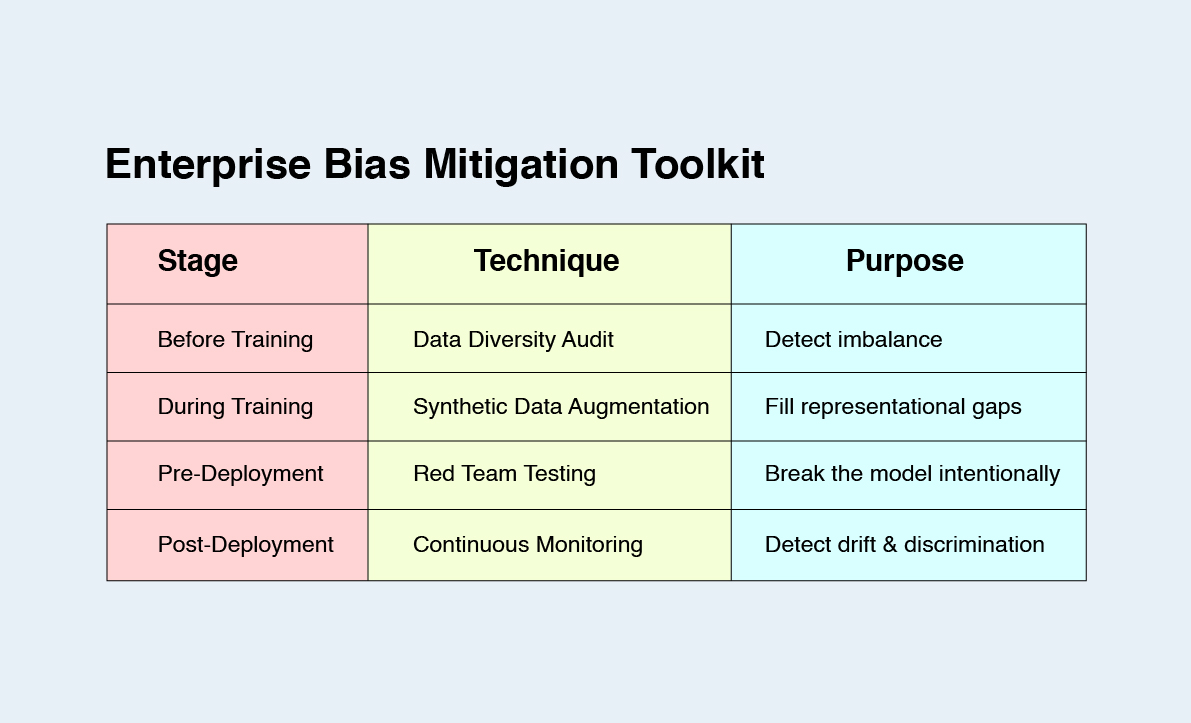
AI bias is rarely deliberate; it is typically inherited from historical datasets. Models trained on skewed or incomplete data will replicate those distortions at scale.
To mitigate this risk, mature organizations are institutionalizing proactive controls:
Before model training begins, datasets are evaluated for demographic representation, sampling imbalance, and proxy variables that may introduce indirect discrimination.
Privacy-preserving synthetic data is used to address representational gaps while maintaining compliance with data protection regulations.
Independent red teams intentionally stress-test models to surface hidden bias, edge-case vulnerabilities, and unintended discriminatory patterns prior to production release.
Bias mitigation is not a one-time intervention; it is a lifecycle discipline requiring continuous monitoring and recalibration.
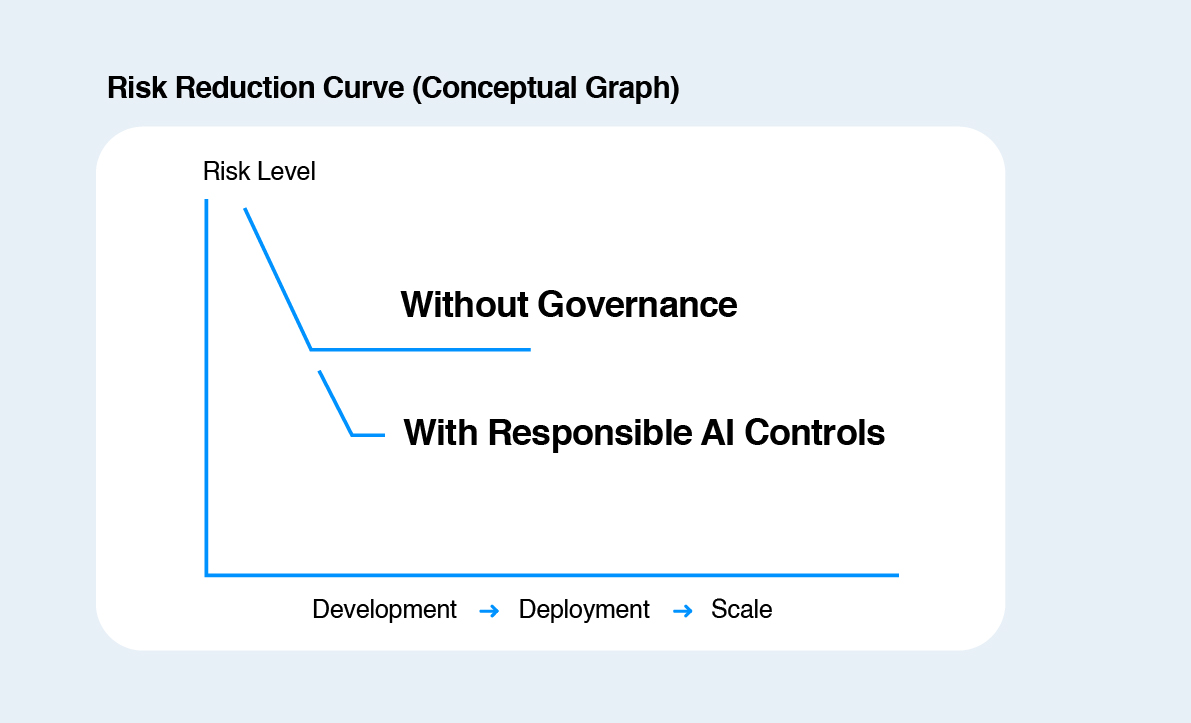
“Ethics” is a philosophy; “Governance” is a process. To scale safely, companies are adopting formalized governance structures:

Organizations do not need to build governance structures from first principles. Several global standards now serve as reference architectures for Responsible AI compliance:
A lifecycle-based framework structured around four core functions: Govern, Map, Measure, and Manage. It provides practical guidance for identifying and mitigating AI risks across development and deployment phases.
The first certifiable AI management system standard, establishing requirements for organizational governance, risk management, and continuous improvement in AI systems.
A risk-tiered regulatory regime that classifies AI systems by impact level, imposing stringent obligations on high-risk applications and prohibiting systems deemed to pose unacceptable societal harm.
For multinational enterprises, alignment with these frameworks is rapidly shifting from optional best practice to operational necessity.
Consumer expectations have evolved. Automated decisions that lack clarity or fairness erode brand equity. Conversely, demonstrable Responsible AI practices enhance stakeholder confidence and long-term enterprise resilience.
Ethical AI is not merely about litigation avoidance. It is about:
In an environment of accelerating regulatory scrutiny, governance readiness is no longer defensive — it is strategic.
At Binalyto, we believe:
Ethics cannot be retrofitted at the end of an AI initiative. It must be architected from the first line of code, the first dataset, and the first deployment decision.
The question for leadership is no longer whether AI governance is necessary.
The question is whether your governance maturity is aligned with the regulatory and reputational realities of 2026.

Building a Data-Driven Culture: Tools, Capabilities, and Mindset as Strategic Differentiators
Read More

Operationalizing AI: Governance, Risk, and Scalability in Enterprise Adoption
Read More

From Data to Decisions: The Enterprise Shift Toward Augmented Analytics
Read More
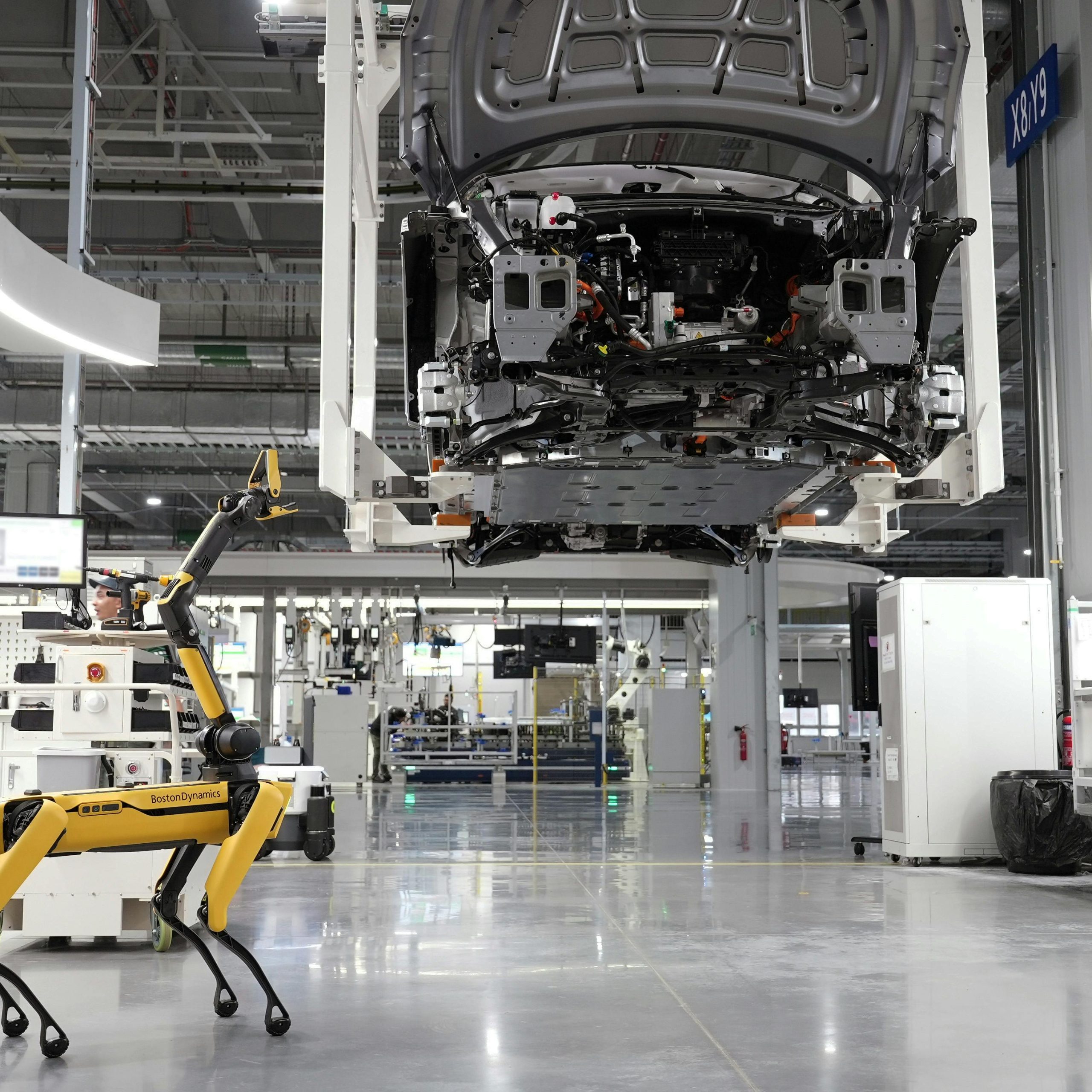
Eyes Everywhere: How Computer Vision Is Redefining Quality Control at Scale
Read More

Edge AI and Real-Time Analytics: Architecting Intelligence at the Point of Action
Read More

AI-Driven Personalization: Engineering Customer Experience at Enterprise Scale
Read More

AI & Ethics in Business: Governance, Bias Mitigation, and Enterprise-Grade Responsible AI
Read More

The Business Impact of Predictive Analytics in Supply Chain and Logistics
Read More

Beyond the Prompt: How Generative AI Is Redefining Enterprise Creativity and Innovation
Read More

The Future of Work: AI-Augmented Roles and Enterprise Workforce Transformation
Read More
With over a decade of enterprise expertise, we deliver performance-driven solutions powered by intelligent innovation. Partner with us to scale smarter, operate stronger, and lead with measurable impact.
Request a Demo

©2026 Binalyto Pvt Ltd.